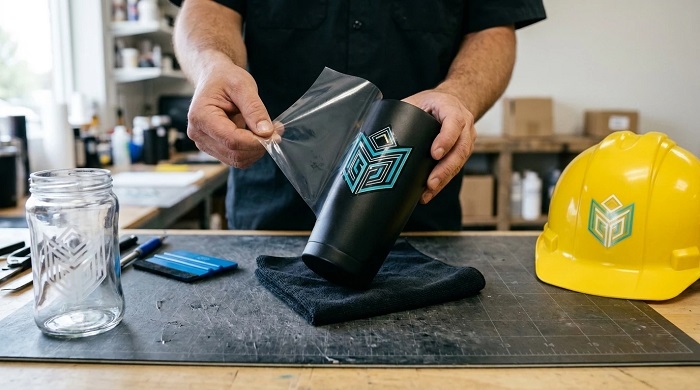
When commercial print shops compare a roll-to-roll UV DTF (ultraviolet direct-to-film) printer against a direct-to-object UV flatbed printer, the core operational difference comes down to substrate geometry and setup time: a UV flatbed jets ink directly onto flat or jig-mounted objects inside a fixed bed height, whereas a roll-to-roll UV DTF system prints and laminates pressure-sensitive crystal transfers onto continuous A/B film that can be applied by hand to curved, tapered, or oversized rigid items without mechanical fixtures.
For B2B promotional product suppliers, packaging decorators, and industrial marking studios, choosing between these two UV curing architectures—or pairing them on the same shop floor—requires analysing how order batch sizes, part shapes, and operator labour interact across real production shifts.
Why Roll-to-Roll UV DTF Eliminates Jig Bottlenecks on Curved and Irregular Parts
Roll-to-roll UV DTF printing outperforms flatbed direct printing on mixed-shape promotional orders because every job runs on the same flat A-film media at a constant printhead-to-film gap, completely removing the need to build custom holding jigs or recalibrate Z-axis clearance between SKUs. On a traditional UV flatbed, printing across a tapered stainless-steel tumbler, an angled industrial ABS helmet, and a recessed gift box lid requires separate fixture trays, rotary attachments, and height adjustments—steps that can consume more setup time than actual printing on short runs of ten to fifty pieces.
With an inline roll-to-roll UV DTF workflow, the printer jets adhesive/primer (depending on system configuration), white ink, CMYK colour, and clear varnish onto release-coated A-film, cures the layers immediately under UV LED lamps, and laminates the transfer sheet to B-film in one continuous pass:
- Zero fixture changeover across mixed SKUs: Dozens of client logos meant for glass jars, metal toolboxes, lacquered wood cases, and hard plastic housings can be nested onto a single gang roll and printed unattended.
- Consistent printhead gap and sharp edge definition: Because the printheads always fire onto flat film at a fixed standoff distance, fine text and raised varnish textures avoid the ink-mist distortion that occurs when a flatbed head fires across a steep curve or recessed lip.
- Off-Site or split-station application: Printed and laminated B-film transfers can be trimmed and applied at a separate assembly bench—or shipped directly to a client’s warehouse for on-site application onto bulky machinery panels that could never fit inside a flatbed enclosure.
Comparing Roll-to-Roll UV DTF and UV Flatbed Printers Side by Side
Before allocating capital to a new UV printing line, production managers should evaluate how roll-to-roll UV DTF and UV flatbed systems compare across geometry handling, consumable cost, and finishing labour.
| Production Parameter | Roll-to-Roll UV DTF Printer (A/B Film Transfer) | UV Flatbed Printer (Direct-to-Substrate) | Optimal Shop-Floor Choice |
|---|---|---|---|
| Tapered, curved, & oversized items | Applies cleanly by hand to compound curves, cones, helmets, and large installed panels | Limited by bed dimensions, Z-axis height, and cylindrical rotary attachment constraints | Choose Roll-to-Roll UV DTF for irregular, tapered, or oversized hard goods |
| Flat sheet & multi-up jig batches | Requires A/B film consumables plus manual peel-and-stick labour per item | Prints directly onto full rigid boards or pre-loaded multi-cavity jigs with no transfer film cost | Choose UV Flatbed for flat signage boards, acrylic panels, and high-volume identical flat parts |
| Consumable cost structure | UV ink (CMYK + White + Varnish) + A-film + B-film | UV ink (CMYK + White + Varnish) + occasional liquid adhesion promoter | Roll-to-Roll UV DTF trades slightly higher film material cost for zero jig-engineering and setup downtime |
| Surface & application boundaries | Rigid, smooth, non-porous surfaces (glass, coated metal, acrylic, hard ABS/PC); not for soft silicone, fabrics, or exterior car body panels | Flat rigid panels and jigged parts within bed clearance; requires manual primer wiping on low-surface-energy plastics | Use Roll-to-Roll UV DTF for rapid multi-SKU rigid merchandising; keep flat architectural panels on Flatbed |
Where UV DTF Transfers Encounter Physical Limits
While roll-to-roll UV DTF eliminates fixture bottlenecks on hard goods, print shops must enforce strict substrate boundaries so sales teams do not over-promise on incompatible materials. UV-curable ink cross-links into a rigid, scratch-resistant polymer layer— especially when topped with high-gloss embossing varnish.
Because that cured ink layer does not stretch like cast vinyl or textile plastisol, standard UV DTF transfers should not be applied to soft silicone promotional items, thin flexible LDPE squeeze tubes that bend repeatedly in the hand, or apparel fabrics. Similarly, although UV DTF adheres tightly to smooth indoor glass and powder-coated metal, shops should not sell standard UV DTF crystal labels as guaranteed dishwasher-proof drinkware coatings, food-contact interior graphics, or exterior automotive body-panel decals exposed to years of road UV and thermal expansion. Running a 24-hour dwell adhesion test on any unfamiliar textured powder coat or low-surface-energy plastic before confirming a production order protects shop margins.
Selecting Industrial Roll-to-Roll UV DTF Hardware for High-Utilization Runs
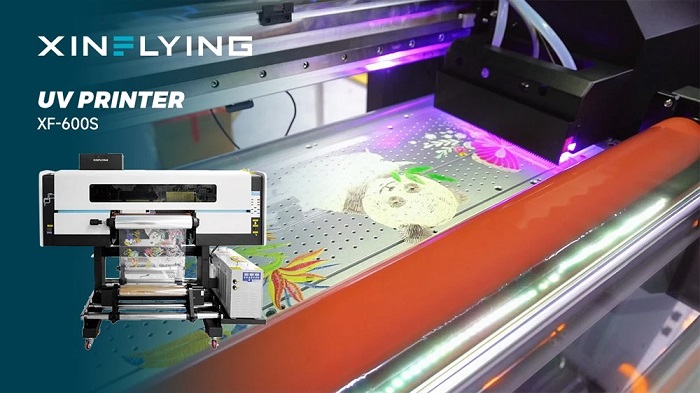
When a print shop’s order book centres on short-to-medium batches of diverse rigid promotional goods, packaging labels, and hard-hat or equipment markings, a dedicated 60 cm roll-to-roll line provides the nesting width and inline lamination stability needed to keep unit costs predictable. Operations managers evaluating four-head industrial platforms such as the XINFLYING XF-600S roll-to-roll UV DTF printer—or comparing compact 42 cm and 45 cm configurations like the XF-420S and XF-450S—can review the complete specifications across XINFLYING roll-to-roll UV DTF printer machines to match printhead count and roll width to their weekly gang-sheet demand.
By pairing an inline A/B-film roll-to-roll system like the XINFLYING XF-600S with disciplined gang-sheet nesting and realistic manual-application pricing, commercial print shops can turn fragmented, multi-shape hard-goods orders into a fast, fixture-free revenue stream.